Regional beta launch readiness
Fictional showcase · 19 August 2026 · conditional go
This brief follows a fictional launch review for Driftwood Rooms, an invented collaborative planning product from the fictional North Quay Labs. Every user, cohort, metric, threshold, and date is sample data created for the report engine; none describes a real product, company, or market result.
Launch signal
Audience
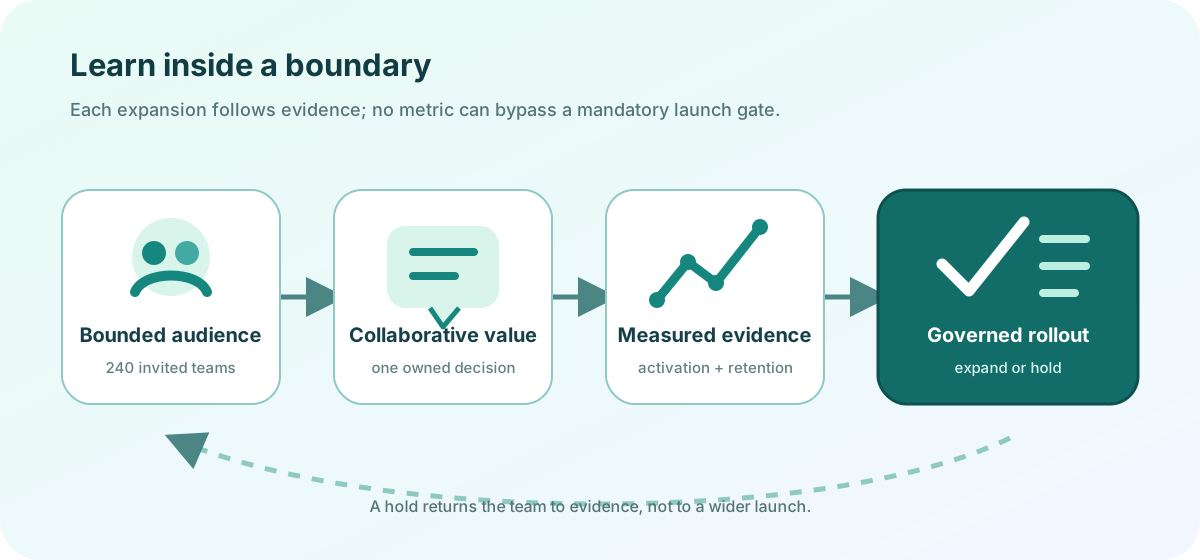
240 invited teams
Design, research, and operations groups coordinating recurring decisions.
Activation
64% · target ≥ 60%
Teams that created a room, assigned an owner, and closed one decision in seven days.
Week-two retention
54% · target ≥ 50%
Activated teams returning with at least two collaborators.
Launch blockers
0 open · target 0
No unresolved severity-one issue or missing mandatory launch gate.
Who gets value first
Audience evidence
Weekly planning rooms replace scattered status threads with one decision, owner, and review date. In the fictional research sample, 18 of 24 activated product teams closed a decision during their first week.
Handoff rooms keep exceptions, accountable owners, and exit conditions together. Eleven of 16 activated operations teams returned for a second workflow without facilitator help.
Single-participant rooms show weak repeat value, and mobile attachment review remains slower than desktop. The beta excludes regulated casework and makes no claim about enterprise-wide adoption.
Activation evidence
- Activated within seven days
- Teams
| Decision signal | Launch threshold | Observed sample | Assessment |
|---|---|---|---|
| Seven-day activation | ≥ 60% | 64% | Pass |
| Week-two retained teams | ≥ 50% | 54% | Pass |
| Median room setup | ≤ 8 min | 6 min | Pass |
| Severity-one product issues | 0 | 0 | Pass |
| Rehearsed support first reply | ≤ 10 min | 7 min | Pass |
Launch gates and ownership
| Workstream | Owner | Mandatory condition | Current evidence | State |
|---|---|---|---|---|
| Data handling | Trust | European Economic Area storage and support access | Rehearsed 14 Aug | Pass |
| Product quality | Engineering | Zero unresolved severity-one issue | Triage closed 18 Aug | Pass |
| Support readiness | Support Operations | First reply within 10 minutes during rehearsal | 7 minutes on 17 Aug | Pass |
| Exit route | Product Operations | Invitation pause and workspace export tested | Exercise passed 18 Aug | Pass |
Gate rule: a failed row changes the launch decision to hold. Improving a funnel or retention metric cannot compensate for a missing mandatory condition.
Regional boundary
The fictional evidence covers one language set, one support rotation, and European Economic Area data handling. A wider launch would change the operating model and invalidate the current capacity and retention assumptions.
Automatic hold condition
Pause new invitations if week-two retention falls below 50% in either of the first two beta cohorts, support first reply exceeds 10 minutes during two rehearsals, or any mandatory gate loses current evidence.
Read the experiment limits
The sample uses invited design partners rather than a random market sample. Activation and retention are directional operating thresholds, not statistical proof of product-market fit. The cohort trend includes no seasonality adjustment, and the funnel does not estimate paid conversion.
Decision and rollout
Go: bounded European Economic Area beta
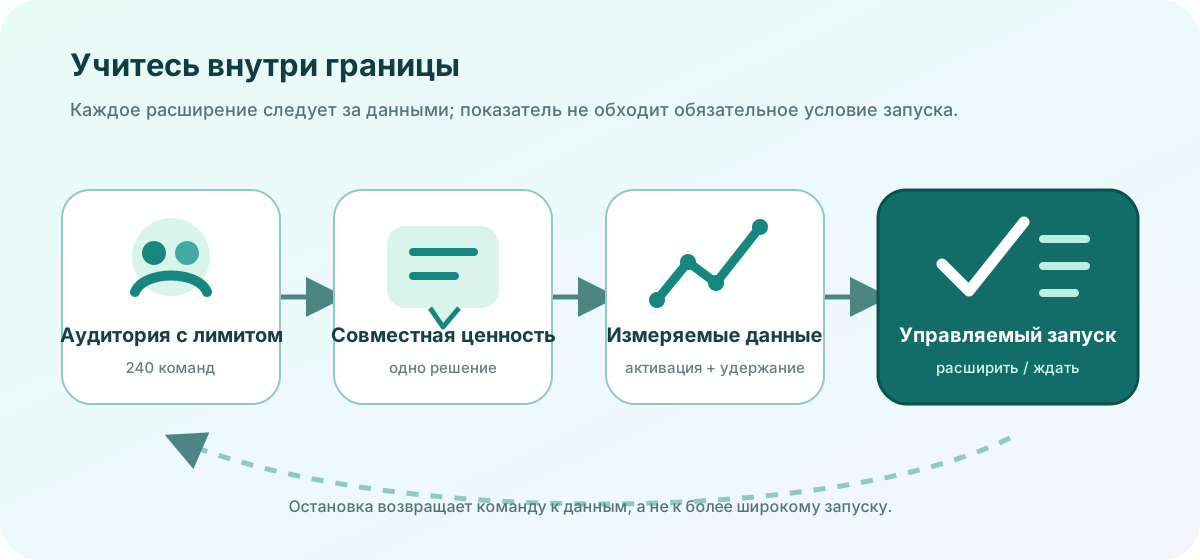
Launch on 15 September for no more than 240 invited teams. Product Operations owns the invitation cap; Trust owns the weekly data-handling check; Support owns the response rehearsal. Hold expansion when any mandatory gate fails or either automatic hold condition is reached. A go decision for this beta is not an approval for general availability.
Evidence locked
Checkpoint
Freeze gate evidence, experiment definitions, invitation owners, and the support escalation tree.
Bounded beta opens
Access opens
Invite the first 80 teams with regulated workflows disabled and daily support review enabled.
Two-week evidence reviewed
Evidence review
Compare activation, retained teams, incident state, and support response with the written thresholds.
Expand or hold
Checkpoint
Add the remaining invitations only after two passing cohorts; otherwise stop intake and close the learning loop.
- Checkpoint
- Access opens
- Evidence review
Run the launch review
- Confirm every gate has a current owner, evidence date, and failing consequence.
- Recalculate activation and retention from the frozen cohort definitions.
- Exercise the support escalation and invitation-pause controls before opening access.
- Record the expand-or-hold decision with the evidence that changed it.