OrbitDesk P1 incident review
Fictional showcase · 18 July 2026 · final review
This demonstration follows a realistic incident at OrbitDesk, an invented subscription platform. Every organization, event, metric, and decision on this page is sample data created to show the report engine; none describes a real company or production system.
Impact signal
Customer impact
18.4% peak failures
Checkout errors were elevated from 09: to 10:.
Recovery
47 minutes
The error budget stopped burning after retry traffic was capped.
Data integrity
No loss found
Ledger reconciliation matched all accepted payment events.
Follow-up
4 owned actions
Two prevention items, one detection improvement, and one preparedness drill are tracked below.
Impact curve
- Failure rate
What failed
- Cause
- Point of failure
Diagram in words
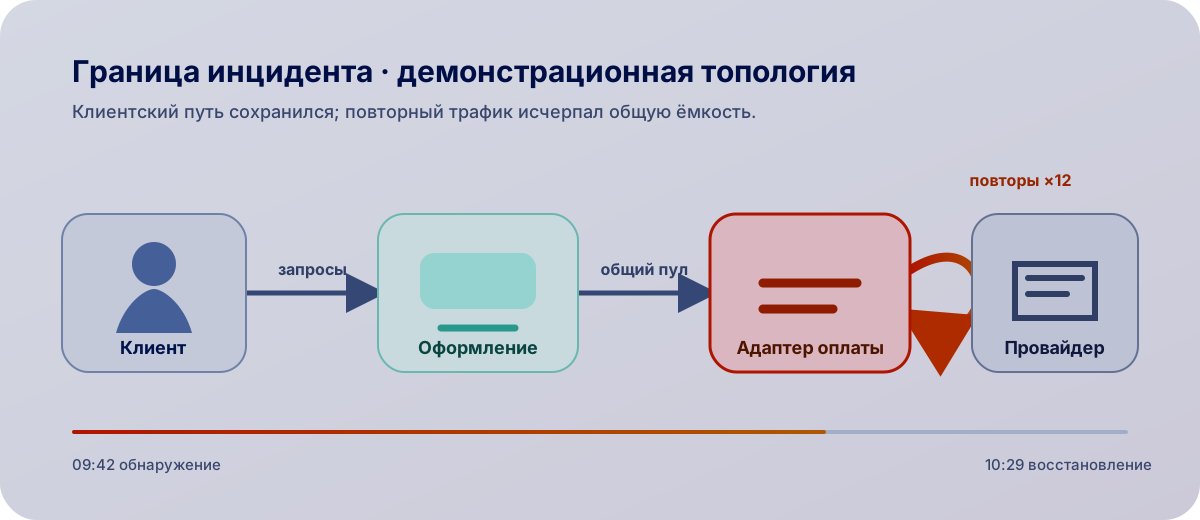
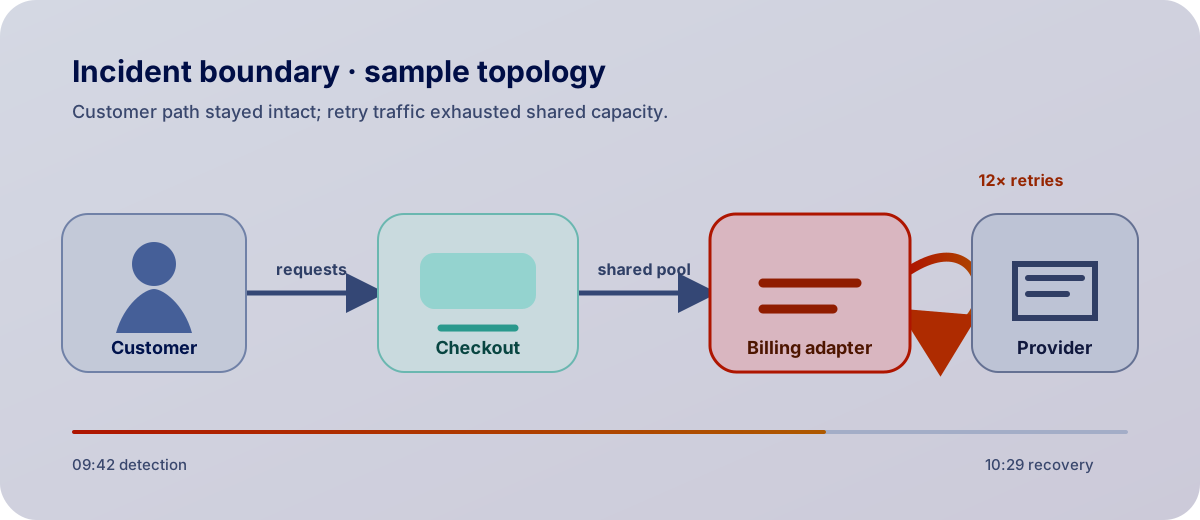
Nodes: 4; flow layers: 4.
Layers along the flow
- Provider timeout [Cause]
- Retry amplification [Cause]
- Pool saturation [Point of failure]
- Checkout failure
Connections along the flow
- Provider timeout → Retry amplification: replayed calls
- Retry amplification → Pool saturation: 12× traffic
- Pool saturation → Checkout failure: no connections
Evidence and limits
- Billing adapter retries rose twelvefold before checkout saturation.
- Pool wait time, not database latency, tracked the customer error curve.
- Limiting retries reduced errors before any application deployment.
- H1 — supported: uncapped billing retries amplified the provider timeout and exhausted the shared pool.
- H2 — rejected: a database regression caused checkout failures; database latency stayed normal while pool waits rose.
- H3 — rejected: a release changed checkout behavior; no deployment, migration, or flag change occurred in the incident window.
- H4 — open: an external provider fault caused the nine-minute timeout; provider evidence is still pending.
- Ledger and order-store writes remained within their normal latency bands.
- No schema migration or feature flag changed during the incident window.
- Reconciliation found no duplicated accepted payment event.
The sample review cannot establish why the provider timeout lasted nine minutes; that question belongs to the external-provider review and does not change the verified internal amplification mechanism.
Response timeline
Alert fired
Detection
Checkout success dropped below the 98% service objective; the incident commander declared P1.
Failure isolated
Response
The team correlated checkout connection waits with retry volume from the billing adapter.
Retries capped
Response
Traffic policy limited adapter retries and shed non-critical reconciliation work.
Service recovered
Recovery
Checkout success held above 99% for ten minutes and the incident moved to monitoring.
Integrity verified
Recovery
Payment, order, and ledger totals reconciled with no loss or duplicate acceptance.
- Detection
- Response
- Recovery
Corrective action register
Filter corrective actions
- Retry budget — owner: Billing — state: in progress — safeguard: cap attempts and add jitter.
- Pool reservation — owner: Checkout — state: ready for review — safeguard: reserve customer capacity.
- Amplification alert — owner: Reliability — state: planned — safeguard: page on retry ratio.
- Provider timeout drill — owner: Incident command — state: scheduled — safeguard: rehearse degradation.
Keep the shared pool; remove unbounded retries
The evidence does not justify splitting the billing adapter into a new service. OrbitDesk will keep the existing boundary, enforce a retry budget with jitter, reserve checkout pool capacity, and alert on retry amplification. The decision is reversible if load testing shows isolation is still required.
Open the customer communication draft
Between 09: and 10:, some fictional OrbitDesk customers could not complete checkout. Existing
subscriptions and stored records remained safe. Service is restored, delayed renewals have been replayed,
and safeguards are being added to prevent retry traffic from exhausting checkout capacity.
Exit criteria
Close the review
- Replay the production-shaped retry scenario in load testing.
- Confirm checkout capacity remains available during provider timeouts.
- Exercise the new amplification alert in the incident drill.
- Close each action only with linked, reproducible evidence.